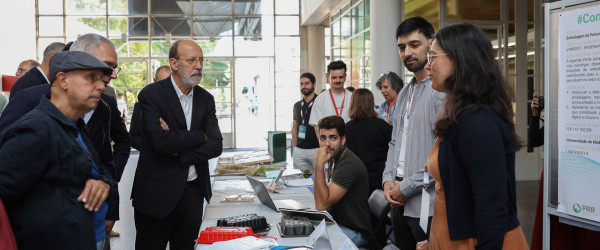
IPC highlights innovation and sustainability at the School of Engineering of the University of Minho Fair
The participation of the Institute for Polymers and Composites (IPC) in the 3rd Inovar & Empreender Fair, organized by the School of Engineering of the University of Minho (EEUM), showcased the Institute’s dynamism and capacity for innovation. The event, held on September 17 at the Azurém campus in Guimarães, brought together 40 entities involved in research, entrepreneurship, and technology transfer, creating an environment dedicated to knowledge sharing and the promotion of collaboration between academia, industry, and society.
On this occasion, the IPC was represented by two flagship projects that reflect its commitment to applied research, sustainability, and technological innovation: INOV.AM and Embalagens do Futuro. Both initiatives demonstrate the Institute’s central role as a strategic partner in scientific and industrial development, effectively addressing the challenges of digital and ecological transition.
INOV.AM aims to drive the advancement of additive manufacturing in Portugal, fostering scientific and technological innovation within the national industry. The initiative seeks to transform the production sector and increase the country’s competitiveness in the international market through the development of new solutions, processes, and advanced materials, with the IPC contributing its expertise in polymers and composites to integrate innovative technologies and facilitate knowledge transfer between academia and industry.
The Embalagens do Futuro project focuses on the creation and commercialization of more sustainable, digital, and inclusive packaging solutions, developed through innovative technologies and sustainable processes. The project aims to generate more than 20 new products resulting from research and development activities, as well as several new production lines that integrate advances in sustainable packaging, including raw materials, product design, molds and tools, processing and manufacturing, information systems and digital transition, social marketing, and recycling. Through this initiative, the IPC reinforces its commitment to sustainability, circular economy, and forward-looking innovation.
Through these projects, the IPC provides concrete examples of how it transforms scientific knowledge into solutions with real impact, contributing to a more competitive, sustainable, and digital industrial sector.